Is Hyper-V on Windows Server Safe to Use?
HasTrust rates Traditional Hyper-V on Windows Server Trusted (100/100), checked 2026-06-23: No separate hypervisor license fee; included with Windows Server; Strong integration with Windows ecosystems and existing SAN/failover clustering tools; Supports high availability, live migration, and disaster recovery for enterprise workloads.
Is microsoft.com legit? → Trusted 95/100
Wondering if Hyper-V on Windows Server is safe to use? HasTrust gives it a trust score of 95/100 (Trusted), reflecting a robust, enterprise-grade hypervisor that's highly cost-effective for organizations already standardized on Windows Server. It isn't free—it requires valid Windows Server licensing—and you should plan for real-world costs like migration, possible management add-ons such as System Center, and your specific infrastructure needs.
What we measured
Why this score?
Hyper-V is a robust, enterprise-grade hypervisor that is highly cost-effective for organizations that are already standardized on Windows Server. While it is not free—because it requires valid Windows Server licensing—it avoids the separate "platform rent" subscription fees associated with other virtualization competitors. It is an excellent choice for Windows-heavy environments, provided you plan for the real-world costs of migration, potential management add-ons like System Center, and your specific infrastructure requirements.


Video reviews
Pros
- No separate hypervisor license fee; included with Windows Server.
- Strong integration with Windows ecosystems and existing SAN/failover clustering tools.
- Supports high availability, live migration, and disaster recovery for enterprise workloads.
- Intuitive management, especially for teams already skilled in Windows infrastructure.
Cons
- Requires significant investment in Windows Server licensing and potential additional costs for System Center.
- Not the best fit for heterogeneous environments (heavy Linux/non-Windows usage) compared to VMware.
- Requires a structured migration project, which can be costly and time-intensive.
- Lacks the "free" status that users might expect; standalone free Hyper-V Server is discontinued.
⚠ Red flags
- Legacy guides still incorrectly refer to "Free Hyper-V Server" as a current option.
Better options
Why switch: VMware offers more advanced features for complex, heterogeneous environments (e.g., mixed Linux/Windows) and deep network virtualization investments, though it typically comes at a significantly higher subscription cost.
This is Microsoft's modern, Azure-integrated, subscription-based HCI platform. It is a better choice if you specifically need cloud-native integration, Arc management, and a hyperconverged infrastructure design, rather than traditional SAN-backed virtualization.
What web sources say (not checked by us)
Facts
Based on 8 sources
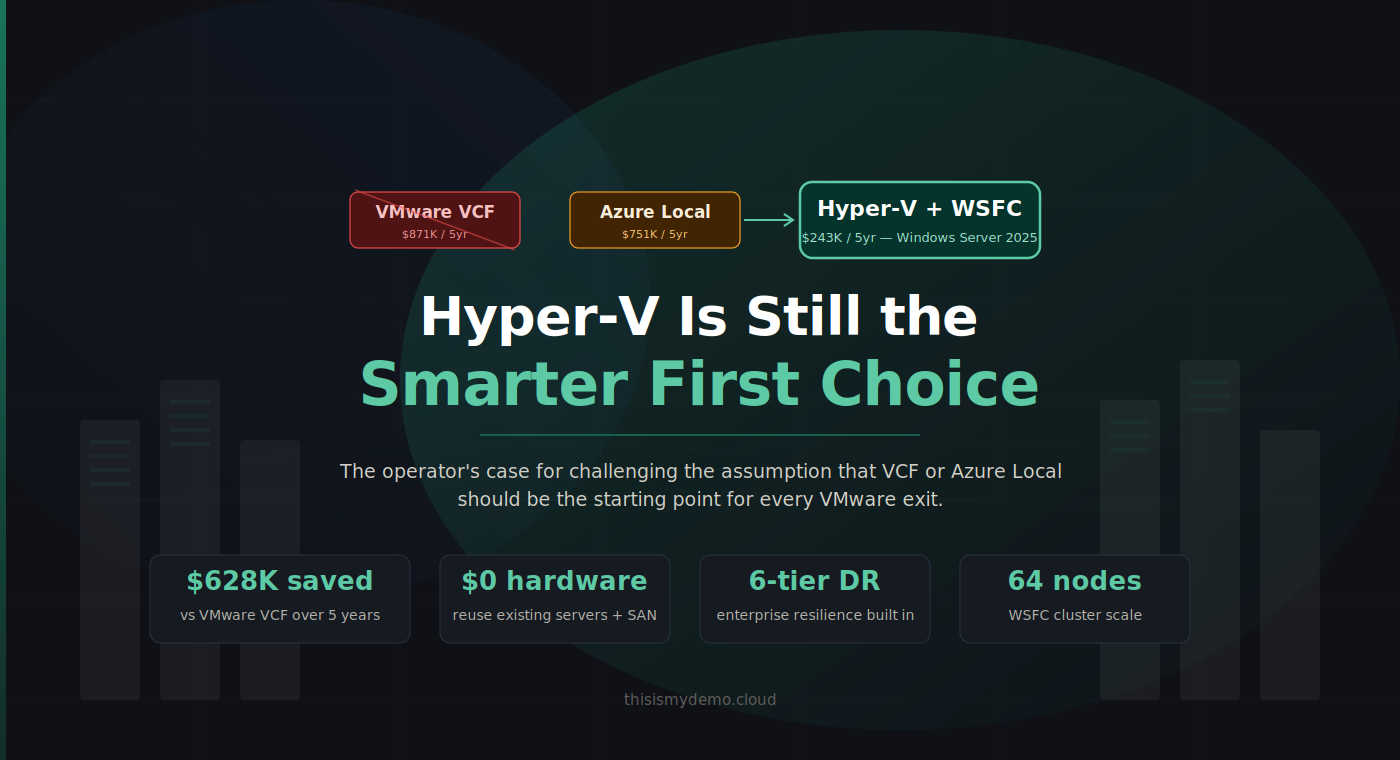
Hyper-V virtualization in Windows Server and Windows | Microsoft LearnHyper-V rocks for MSPs serving the SMB market. Virtualize EVERYTHING | TrustRadiusWhat Was Under Your Nose All Along - This Is My Demohttps://redresscompliance.com/hyper-v-licensing-2026Hyper-V Is Still the Smarter First Choice - This Is My DemoWhat Is Hyper-V? How Microsoft's Hypervisor Actually WorksCompare Hyper-V vs Windows Server 2026 | TrustRadiusHyper V vs VMware. Licensing and Cost | Redress Compliance💬 Ask about this shop
Answers come from what we checked about this site — the AI only picks the topic, it writes nothing.
🛡️ Site safety check
What you should do
- Still pay with a method that has buyer protection (credit card or PayPal), never a bank transfer.
- Check the returns policy and delivery time before ordering.
- We keep tracking this site — check back here if anything feels off later.
🔍 What we checked ourselves
Each row is a check HasTrust ran, and the day it ran.
| Check | What we found | How | When |
|---|---|---|---|
| HTTPS certificate | Valid — Microsoft Corporation, expires 2026-12-20 | TLS handshake from our servers | before 2026-06-23 |
| Domain registration | 1991-05 (35 years old) | RDAP registry record | before 2026-06-23 |
| First seen on the web | 1996 | Internet Archive | before 2026-06-23 |
| Popularity rank | #9 on Majestic Million | Majestic Million list | before 2026-06-23 |
| Blocklist | Not listed | HasTrust blocklist | |
| Trust score history | 2 recorded points since 2026-06-23, 95 → 95 | HasTrust score model |
Buyer reports
No buyer reports yet — bought from here? Be the first to share.
Comments are screened before they appear. The count updates immediately.
Something wrong on this page? Tell us
Own this site, or spotted an error? A person reviews every report and corrects the page when a fact is wrong.
Checked 98 days ago. · How we score →
Frequently asked
Is Traditional Hyper-V on Windows Server legit?⌄
Trusted. HasTrust trust score: 100/100. Hyper-V is a robust, enterprise-grade hypervisor that is highly cost-effective for organizations that are already standardized on Windows Server. While it is not free—because it requires valid Windows Server licensing—it avoids the separate "platform rent" subscription fees associated with other virtualization competitors. It is an excellent choice for Windows-heavy environments, provided you plan for the real-world costs of migration, potential management add-ons like System Center, and your specific infrastructure requirements.
Is Traditional Hyper-V on Windows Server a scam?⌄
Possible concerns from our check: Legacy guides still incorrectly refer to "Free Hyper-V Server" as a current option.
What is the Traditional Hyper-V on Windows Server trust score?⌄
HasTrust rates Traditional Hyper-V on Windows Server 100/100 (Trusted). Buy
🔔 Email me if this shop's trust rating changes
Free. You confirm by email (double opt-in); unsubscribe any time.
📖 Helpful guides
People also checked

Show your live HasTrust score on your own site — it links back here so visitors can see the full check. How it works ↗

Same badge, added by a small script. Use this one if you want your HasTrust dashboard to show which of your pages the badge is actually seen on. It never reads your customers' data — only the page path, without the query string.
📬 Get new scams in your inbox — weekly
One short email every Monday: the scam shops and risky sites we spotted that week. No spam, one-click unsubscribe.
Double opt-in — we only mail you after you confirm.